
Why You Always Feel Like a Fraud at the Start Line (...and why you're actually not)
The Feeling
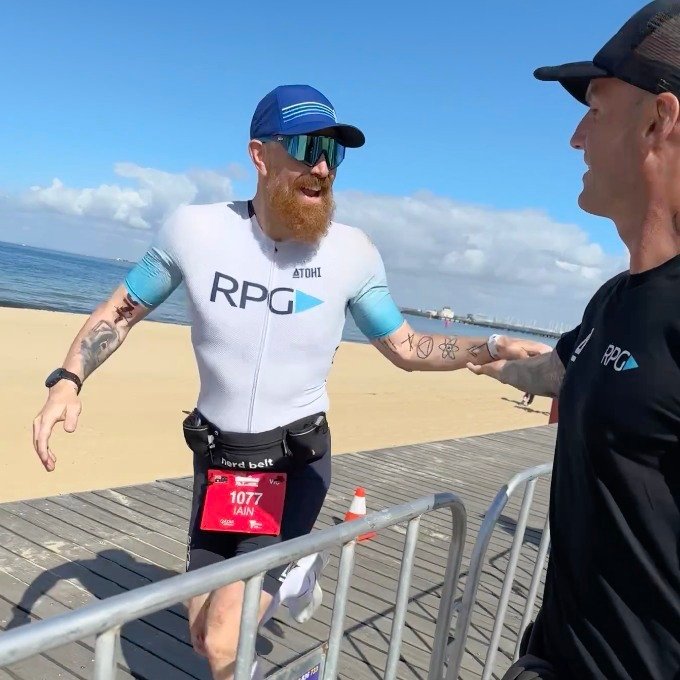
You've been here, right? You're standing under the blow-up arch, AC/DC playing, wetsuit zipped to your throat, goggles fogging. Around you, 1000+ people are doing the same nervous shuffle. The pros have already started and damn, they look fast. Earlier, you watched someone casually adjusting a $15,000 bike on the rack like it was a shopping trolley. A volunteer shouts something through a megaphone that the wind immediately eats.
And the voice in your head says: What are you doing here? You're not one of these people. You had a meat pie on Tuesday, and you didn't finish the entire swim set over weekend.
The Reframe
Here's the thing. That voice isn't a sign that you don't belong. It's a sign that you care enough to show up and honest enough to feel the gap between where you are and where you'd like to be. And it has a name.
Psychologists Pauline Rose Clance and Suzanne Imes first described the "impostor phenomenon" in 1978, studying high-achieving women who believed their success was down to luck, timing, or just being really good at faking it. Since then, research has shown it affects up to 70% of the general population at some point, and it's particularly common in competitive, performance-focused environments. Like, say, the transition area of an Ironman 70.3 at 5:45am on a Sunday.
The Science
Impostor phenomenon isn't about actually being incompetent. It's about being unable to internalise your competence. You did the training. You entered the race. You're literally wearing the uncomfortably tight suit. But your brain won't file that under "evidence I'm a triathlete." It files it under "elaborate con I'm somehow pulling off."
Think of it like a spam filter on your email. Positive evidence about yourself (finishing a training block, getting a PB in a park run, surviving open water without panicking) gets quietly redirected to junk. Negative evidence (that one session you skipped, the bloke who overtook you on the bike, the fact that Kristian Blummenfelt even exists) lands straight in your primary inbox, bolded, with a red flag.
The filter isn't broken. It's just miscalibrated. Clance described this as the "impostor cycle": you face a challenge, feel anxious, then either overprepare obsessively or procrastinate, and when you succeed, you attribute it to effort or luck, never ability. The cycle resets. The doubt comes back. You never update the filter.
It works because of something called external attribution bias: when you succeed, you credit something outside yourself (the course was flat, everyone else had a bad day). When you fail, you credit something inside yourself (I'm slow, I'm not built for this). It's a one-way ratchet. Failure confirms your worst theory about yourself. Success doesn't count.
For age-group triathletes, this is turbocharged. You're surrounded by people you perceive as "real athletes" while quietly believing you're just a person who happens to own a wetsuit and a mid-life crisis. But here's what the research on athletic identity tells us: being an athlete isn't a biological category. It's a cognitive structure and a social role. Brewer, Van Raalte and Linder, who developed the Athletic Identity Measurement Scale, defined it as the degree to which an individual identifies with the athlete role. Not the degree to which you're fast. The degree to which you identify.
You're standing at the start line. You identify enough to be there. The filter just hasn't caught up.
The "So What" for Athletes
The difference between the person who thrives on the start line and the person who quietly spirals into a panic attack dressed in neoprene isn't that one feels confident and the other doesn't. It's that they interpret the same feeling differently.
Research on cognitive reappraisal shows that reframing how you interpret a situation, without changing the situation itself, significantly reduces anxiety and improves performance. Harvard researcher Alison Wood Brooks found that people who reappraised their pre-performance anxiety as excitement (literally saying "I am excited" out loud) significantly outperformed those who tried to calm down. Anxiety and excitement are physiologically almost identical: both aroused states with a racing heart and heightened alertness. The difference is just the label you slap on it. Read those last two sentences again slowly, if you wouldn’t mind.
So when your heart is hammering and your brain is saying you don't belong here, that's not a signal to retreat. That's your body doing exactly what it's supposed to do. The people with the 'better coloured' swim caps? Their hearts are hammering too. They've just learned to call it something different.
The Practical Toolkit
Four things you can actually say to yourself at the start line (or in T1, or at kilometre 8 when everything hurts):
"I trained for this. That's not luck, that's Tuesday nights after work."
"I am excited." (Say it out loud. Brooks's research says it works better that way.)
"The feeling is the proof, not the problem. If I didn't care, I wouldn't be nervous."
"Calling myself a triathlete isn't arrogant. It's accurate. I entered a triathlon. That's literally what the word means."
The Landing
Every person who has ever stood on a start line has heard some version of that voice. The fast ones, the slow ones, the ones who look like they were born in Lycra, and the ones who bought their bike from the aisle of dreams at Aldi. Impostor phenomenon isn't a sign that you're in the wrong place. It's a sign you're in a place that matters to you.
Now go race.
Iain Davis
About the author, Iain Davis:
Iain is a 44-year-old father of three who, in his professional life, works as a clinical psychologist in private practice, specialising in complex PTSD. Increasingly, though, his curiosity has pulled him toward the psychology of human performance — what actually happens in the mind when people push themselves, face doubt, and find their limits. Age-group triathlon, it turns out, is an excellent laboratory for all three. He arrived proudly and somewhat later in life into that wild world, where he remains enthusiastically mid-pack and endlessly curious about the small improvements that come with turning up consistently, even when the swim set looks terrifying.